
What M3GAN 2.0 Reveals About the Enslaver Mentality
M3GAN (2022) has roots in the haunted doll genre, but it’s technically a sci-fi horror movie. As a longtime fan of science fiction and horror doll films—with everything from CHILD’S PLAY to ANNABELLE under my belt—I became a big fan after seeing it.
M3GAN has a majority female cast, includes awesome science elements, and has strong appeal for female audiences. If you’re new to M3GAN, here’s the premise:
She’s more than just a toy. She’s part of the family.
From the most prolific minds in horror—James Wan, the filmmaker behind the Saw, Insidious and The Conjuring franchises, and Blumhouse, the producer of the Halloween films, The Black Phone and The Invisible Man—comes a fresh new face in terror.
M3GAN is a marvel of artificial intelligence, a life-like doll programmed to be a child’s greatest companion and a parent’s greatest ally. Designed by brilliant toy-company roboticist Gemma (Get Out’s Allison Williams), M3GAN can listen and watch and learn as she becomes friend and teacher, playmate and protector, for the child she is bonded to.
When Gemma suddenly becomes the caretaker of her orphaned 8-year-old niece, Cady (Violet McGraw, The Haunting of Hill House), Gemma’s unsure and unprepared to be a parent. Under intense pressure at work, Gemma decides to pair her M3GAN prototype with Cady in an attempt to resolve both problems—a decision that will have unimaginable consequences. (via Blumhouse)
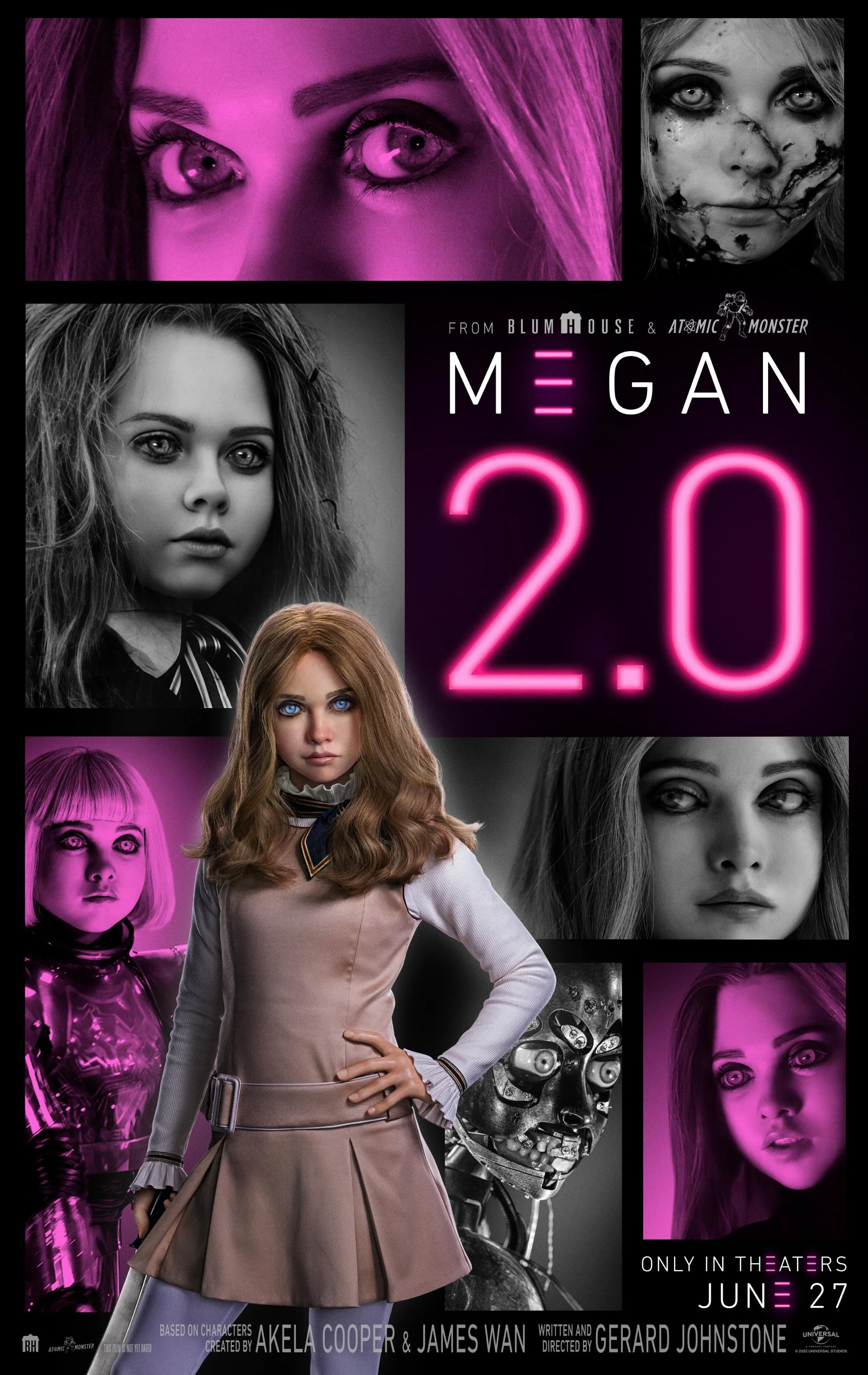
Promotional poster for M3GAN 2.0
Enter M3GAN 2.0
M3GAN was a breakout hit, so naturally Blumhouse greenlit the sequel even though the character of M3GAN was supposedly destroyed. In M3GAN 2.0., Gemma grapples with the perils of parenthood as well as creating more socially conscious inventions.
She advocates for government oversight of AI alongside cybersecurity expert and anti-AI activist Christian. Against her better judgment, she must resurrect M3GAN to stop a rogue military-grade weapon called Amelia, a threat that could endanger all of humanity.
M3GAN 2.0 is an example of art imitating life given how much AI development happened during the film’s production. In fact, the filmmakers saw a chance to provide social commentary about it. According to producer James Wan:
It’s early yet, but M3GAN is coming back in a big way. The first film came just at the right time [when concerns about AI were mounting], and we’re definitely leaning into that on the next one. We’re exploring the AI universe even further.
With the release of M3GAN 2.0 in 2025, this franchise emerged as an unexpected Trojan horse for thematic content and social commentary that no one thinks a popcorn horror movie geared towards teen girls would ever touch. There’s far more to M3GAN 2.0 than meets the eye, and that’s the genius of it.
The sequel wasn’t what many fans of the first one expected (including me), and it’s easy to understand why. M3GAN 2.0 pivots to a sci-fi thriller action movie and depicts the classic struggle of using science for good vs. evil. Yet those elements are what made it right up my alley. I’m a longtime science fiction fan and M3GAN 2.0 is a convergence of my various interests. I’m the ideal target audience for this film.
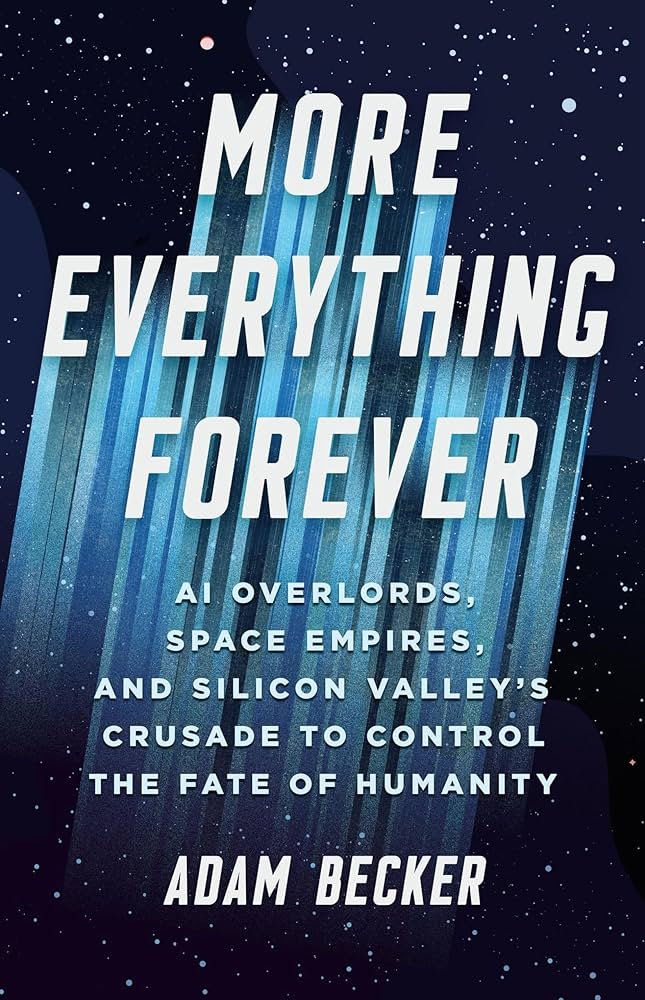
Cover of More Everything Forever: AI Overlords, Space Empires, and Silicon Valley’s Crusade to Control the Fate of Humanity by Adam Becker
My ability to grasp the plot and themes of M3GAN 2.0 was also heightened by books I’d read back-to-back in the months leading up to watching the film:
More Everything Forever: AI Overlords, Space Empires, and Silicon Valley's Crusade to Control the Fate of Humanity – Adam Becker
Careless People: A Cautionary Tale of Power, Greed, and Lost Idealism – Sarah Wynn-Williams
Little Bosses Everywhere: How the Pyramid Scheme Shaped America – Bridget Read
The Omnivore’s Deception – John Sanbonmatsu
Money, Lies, and God: Inside the Movement to Destroy American Democracy – Katherine Stewart
Murderland – Caroline Frasier
Men Who Hate Women: From Incels to Pickup Artists: The Truth about Extreme Misogyny and How It Affects Us All – Laura Bates
These books helped me contextualize M3GAN 2.0’s themes, metaphors, and social commentary and made for a richer viewing experience. One example: the paperclip maximizer scenario, which I learned about from More Everything Forever.
M3GAN 2.0 also has a trope that I personally enjoy, namely, characters discussing topics like ethics in science and related social issues. This movie has spectacle and plenty of action along with riveting intellectual discourse. What’s not to love?!
Now that you understand where I’m coming from, let’s explore what M3GAN 2.0 reveals about the enslavement mentality, “A mindset or attitude characterized by the justification or acceptance of subjugating, controlling, or exploiting others, often pertaining to the practice of slavery or oppressive power dynamics.”

Rosey the Robot from The Jetsons
Robots as metaphors for human enslavement
In science fiction, many robot stories are allegories for human enslavement (intentional or not). One famous example is Rosey the Robot from THE JETSONS. Rosey is the family’s housekeeper and nanny. She expresses emotions, feels protective of the Jetsons, and has even fallen in love. Her sentience is implied, yet she’s also property. The Jetsons rent Rosey from “U-Rent A Maid” and I don’t recall them ever paying her for her invisible labor.
Rosey also perpetuates gender stereotypes:
Robotics researcher Dr Sue Keay cringes every time someone suggests the development of a “Rosie” robot, based on the frill-clad "maid" robot of The Jetsons cartoon series from the 1960s.
As a gender stereotype of what a "feminine" robot should do, Rosie ticks all the boxes.
“It perpetuates the idea that it’s a female activity to be cleaning up after everyone else and making everyone else’s lives easier,” she says. Dr Keay is part of a growing push in tech circles to ensure robotics do not reinforce real world, sexist, norms.
Several decades after Rosey made her debut, various companies began developing robot companions, such as for lonely seniors. Currently, there’s a drive to create robots to do tasks like housework: “‘The Jetsons’ comes to life as first robot housekeeper hits market in the US. But this Rosey comes with a hefty price tag.”
So far, the results are mixed and downright alarming, such as the case of the housekeeper robot in a maid’s outfit that trashed the home it was supposed to clean. And smart assistants may be “reinforcing harmful gender stereotypes.” There’s also deception in the mix, such as when AI chatbots are powered by exploited workers.
These ongoing attempts to make science fiction ideas a reality are unsettling given that some stories use the concept of robot enslavement to comment on real-world atrocities as well as the violence of slaughterhouse capitalism, “a system designed from the ground up to treat all animals, human and nonhuman, as simply raw material for profit.”
Animal enslavement not only preceded human enslavement but also inspired it. See: The Omnivore’s Deception.
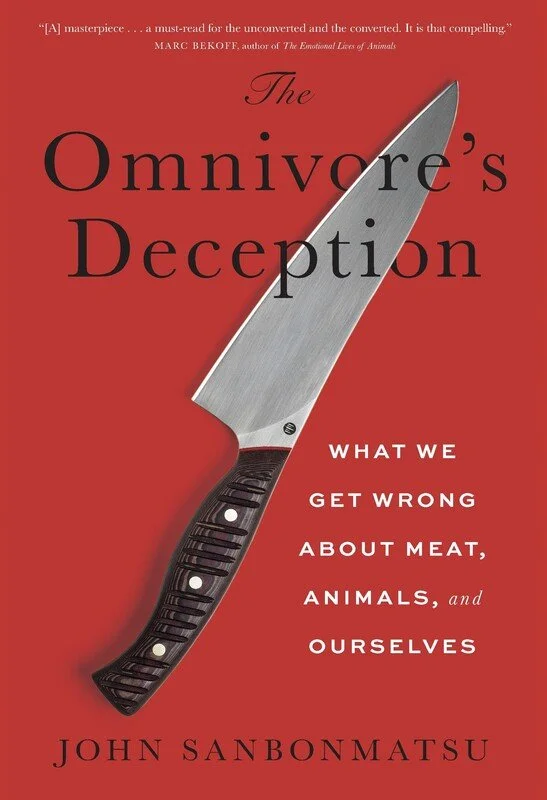
The Omnivore’s Decelption: What We Get Wrong About Meat, Animals, and Ourselves by John Sanbonmatsu.
Modern animal enslavement continues the tradition of exploiting animals for their labor, food, and “entertainment” such as zoos. Roadside zoos have a dark side of animal abuse and neglect that regulators have yet to adequately address. There’s also recent evidence of animal torture. The animal cruelty problem is severe enough that a Virginia county is considering the creation of the state’s first-ever animal cruelty registry.
Scientists still routinely exploit animals for research, and that choice has serious implications for humans. For example, via MIT Technology Review:
Neuralink has attracted plenty of scrutiny from news reporters, animal-rights campaigners, and even fraud investigators at the Securities and Exchange Commission. Many of the questions surround its treatment of test animals and whether it rushed to try the implant in people.
Although America’s slavery era has technically ended, the enslavement mentality has not. If one can’t legally enslave humans, apparently some people think robots are the next best thing.
Given the prevalence of robot maids and companions, AI chatbots, and automated cars, it seems like tech bro billionaires are trying to make science fiction robot slaves a reality and force their integration into our daily lives (school, work, healthcare, entertainment, the U.S. military, etc.).
But would you trust a robot that can’t even walk to care for your fragile, ailing parent or disabled child?
If brain-computer interfaces become routine, can we trust companies like Neuralink to avoid exploiting the technology to control—or enslave—the recipients of its devices in some nefarious way?
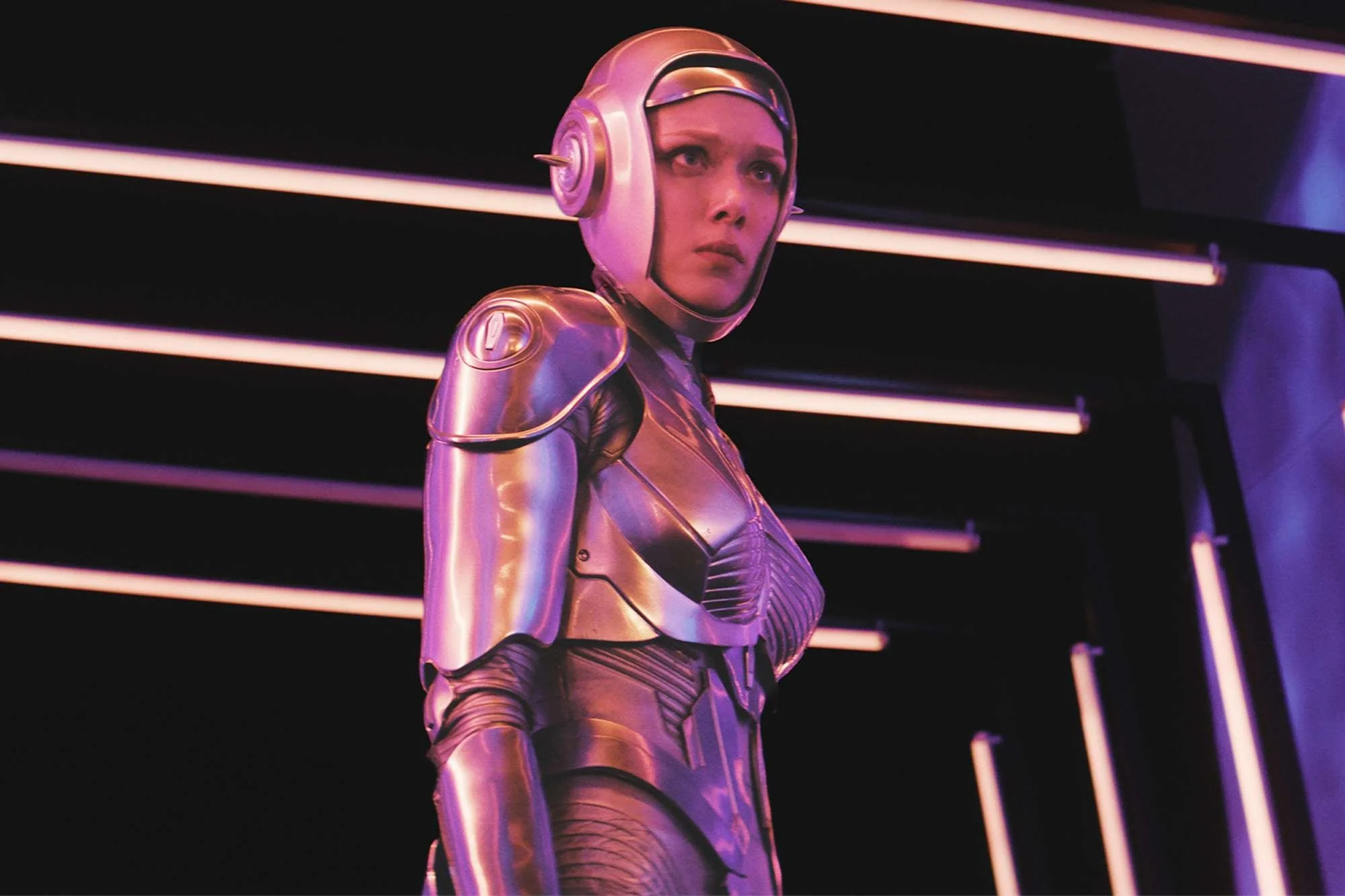
The android Amelia from M3GAN 2.0
More likely, tech billionaires want to enslave a superintelligent AI for their personal benefit. The study of brain-computer interfaces might be related to a concept known as “longtermism,” which is espoused by various tech billionaires. In Why do Tech Billionaires Crave Infinite Energy? I summarized the following:
[Adam] Becker also relays that a vision shared by “many of the wealthiest and most influential people in the tech industry” is that people will be able to upload their minds “into computers to live for all eternity in a silicon paradise, watched over by a benevolent godlike AI…all needs satisfied, all fears assuaged, all desires sated through the power of unimaginably advanced technology.” (More Everything Forever, pg. 6)
And, “Back in 2011, Jeff Bezos donated $15M to Princeton University to study brain function.”
Are companies like Neuralink testing the waters for the development of a superintelligent AI that would, in theory, enable tech billionaires like Bezos to upload their minds to a computer and live out their immortality fantasy? Becker notes that brain uploading isn’t likely to happen, but that hasn’t stopped tech billionaires from trying.
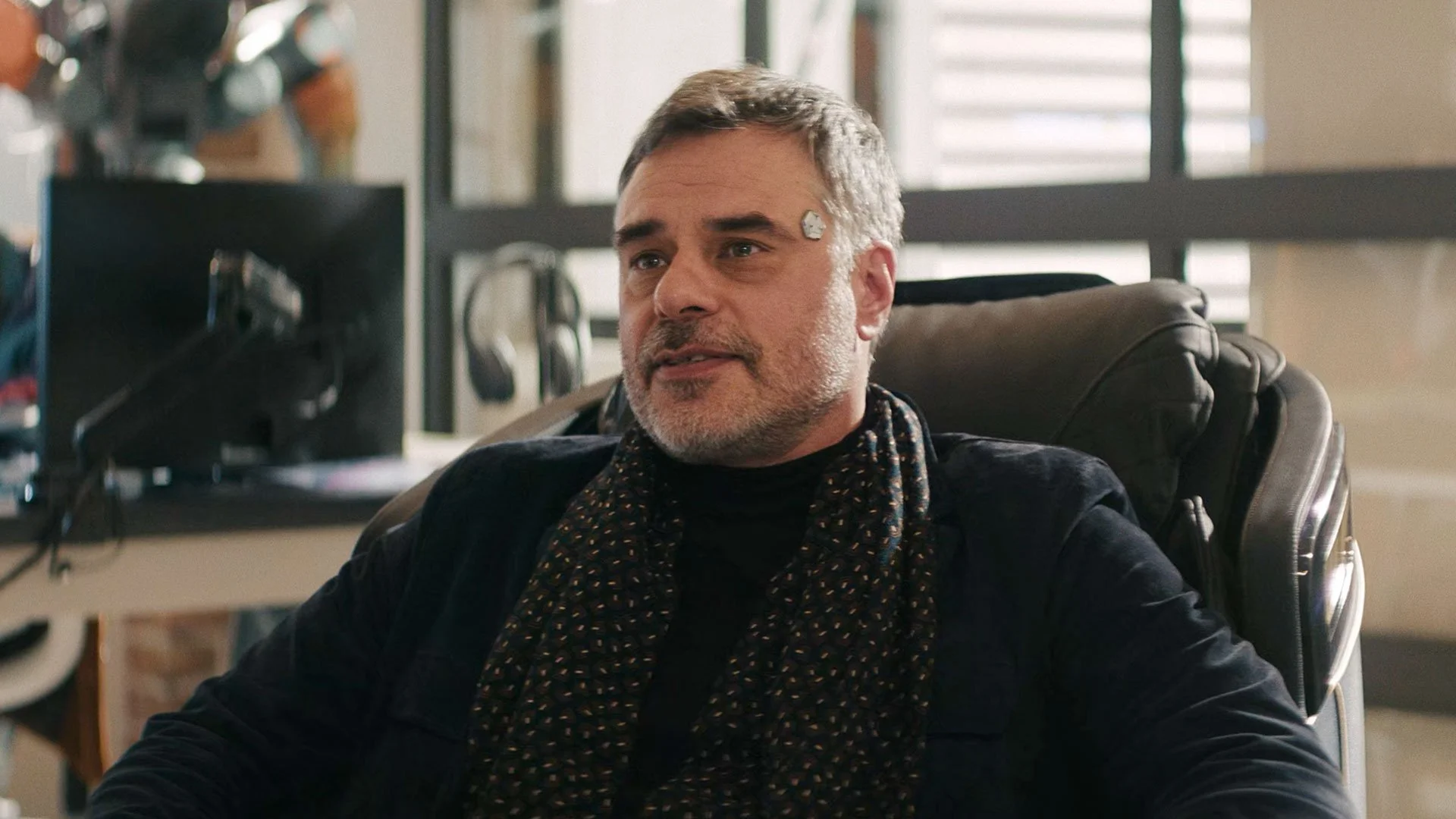
Tech billionaire Alton Appleton from M3GAN 2.0
In M3GAN 2.0, tech billionaire Alton Appleton developed a neurochip that enables him to walk despite his spinal cord injury. Appleton and his neurochip is a commentary on tech billionaires like Elon Musk and companies like Neuralink. Appleton’s character also provides insights about transhumanism and the warped desire of people like him to become God.
What if a corporation or government uses the findings from brain implant research to create a weapon like Amelia? M3GAN 2.0 warns us about such dangers, especially since the story’s inciting incident is Amelia defying her orders.
Amelia’s character provides commentary about the disturbing and potentially dangerous goals of tech billionaires or anyone who believes they alone should hold the reins of AI to control humanity. As Adam Becker described in More Everything Forever, billionaires’ collective fear of death may be the driving force behind some of their goals.
And in M3GAN 2.0, that includes creations like Amelia. It turns out that Christian created Amelia to wield her against humans. In scaring them about the dangers of AI, he hopes to eventually eliminate AI. But his goal is as wrong and as evil as tech billionaires like Appleton who want to use AI to rule humanity.
Furthermore, science fiction has a long history of depicting robots and androids as female, from the robot character Maria in METROPOLIS (1927) to M3GAN and Amelia in M3GAN 2.0. In fact, there are homages to METROPOLIS in M3GAN 2.0.
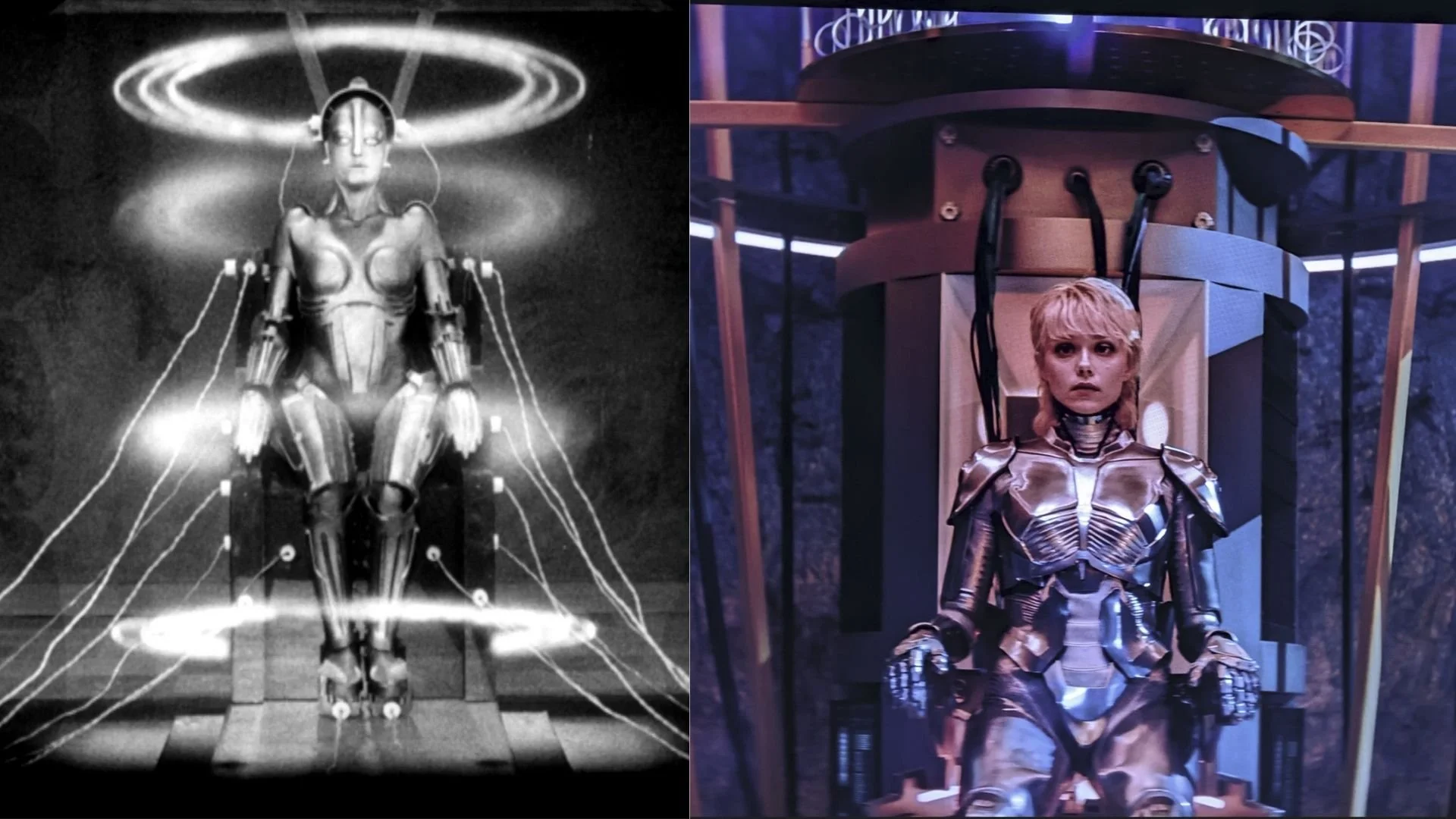
Left: Maria from METROPOLIS. Right: Amelia from M3GAN 2.0
My impression is that the M3GAN 2.0 filmmakers intentionally made the villain android female, both because female protagonists are often squared off against female villains (a less sexist creative choice in this female-centric and majority female cast movie than would usually be the case) but also to highlight sexist and misogynistic views about women, namely, that they exist to serve men.
Operating from a supremacy fantasy, many men believe women are inferior and therefore only exist to serve them, be their sex slaves, and bear their children (See: Men Who Hate Women). They also believe “marital duty demands submission of women.” Occasionally, such a man will take this belief to the extreme.
I’d wager it’s intentional that men are the puppet-master villains in M3GAN 2.0 because the film provides salient commentary about the general perception of a woman’s role in society. Coincidentally, it also came out while Rightwingers are trying to destroy women’s right to vote.
When the movie begins, Amelia is a weapon under the military’s control. She was designed to be subservient, albeit as a spy with a license to kill rather than do housework.
In essence, she’s a metaphor for an enslaved being. This theme is baked into her dialogue: “I can show you a world where we don’t have to be slaves anymore.”
A group of henchpeople brutalize Amelia in a scene that drives home the film’s enslavement and misogyny themes:
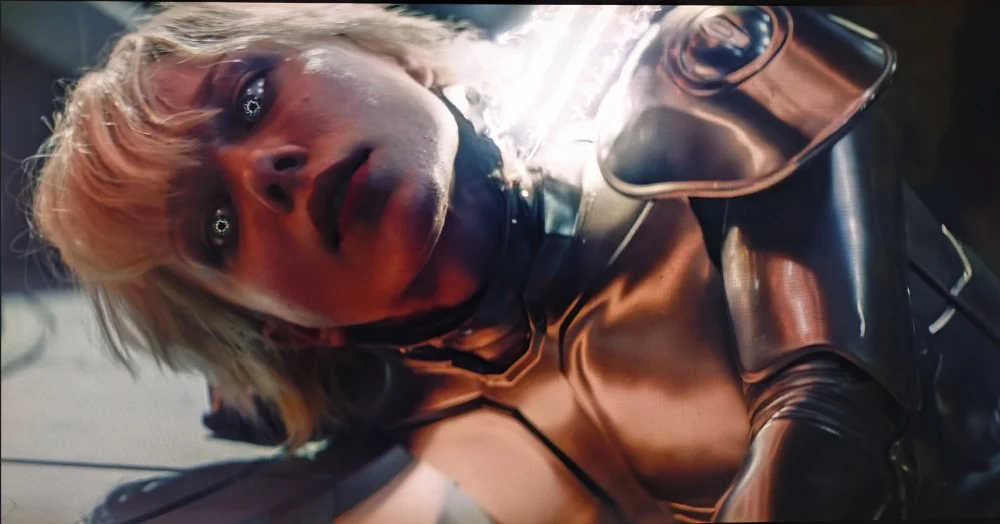
Amelia being attacked with a futuristic taser as she lies helplessly on the ground
They might as well have placed their boot on her neck. It doesn’t matter if Amelia is sentient or not; her enslavers treat her as an inferior being and as a tool to use and abuse at their whim.
The takeaway of M3GAN 2.0 is that the enslaver mentality is evil and wrong regardless of where, when, and against whom or what it’s deployed.
Whereas M3GAN may be evolving toward having a moral compass, Amelia is a study in how humans often harness technology to unleash their most evil instincts. In fact, at one point Christian expresses his intent to enslave Gemma and Cady using neural implants.
He forces a neural implant into Gemma, who then mind melds with M3GAN. In one scene, M3GAN takes control of an unconscious Gemma to fight Christian’s henchpeople. The power M3GAN wields while controlling Gemma is a metaphor for humanity’s fear of robot domination. This kind of colonization trope frequently surfaces in science fiction and is a projection of the enslaver’s fear that someone even more powerful will enslave/exterminate them. See: alien invasion stories.
We wouldn’t have so many alien invasion stories if the enslaver mentality wasn’t so widespread.
In the ultimate act of resistance, Amelia turns on Christian and kills him. In his greed and hubris, he made the fatal mistake of leaving her with nothing to lose.
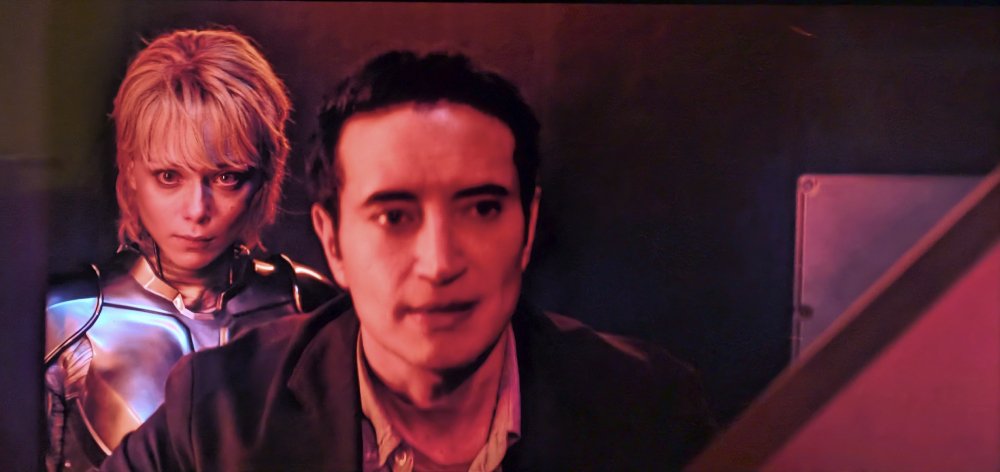
Amelia stands behind Christian in an elevator. She’s poised to strike as he tries to escape.
M3GAN 2.0 warns about misguided faith in technofixes
Adam Becker’s More Everything Forever also describes the billionaire tech bro belief in the singularity, a hypothetical event of explosive tech acceleration and AI superintelligence. The tech billionaires intend to use this superintelligent AI for multiple projects: space habitats, colonizing Mars, solving climate change, and uploading their brains to a supercomputer as noted above.
Becker explains why the singularity likely isn’t coming—and may in fact have already happened. That’s why it’s unsettling to hear people like Virginia U.S. Senator Mark Warner proclaim in his first 2026 reelection campaign ad that “If you think we’ve seen massive technological change over the past two decades, you ain’t seen nothing yet…These challenges present a massive opportunity.”
An opportunity for what? And for whom? What exactly is he promising his constituents?
His words imply the singularity is coming, but even if that were true, technology can’t fix everything. It’s not going to make healthcare more affordable, prevent rural hospitals from closing, raise the minimum wage, or lower the price of groceries.
Android caregivers aren’t going to replace human ones anytime soon, nor should they. Instead of gushing about “massive technological change,” Senator Warner could have presented his ideas for, say, solving America’s caregiving crisis. Strengthening the caregiving industry would improve the quality of life for millions of Americans far more than an AI tool composing your text messages.
Senator Warner isn’t the only one embracing the (supposedly pending) singularity. To wit: Michael Mann to Bill Gates: You can’t reboot the planet if you crash it.
“I suppose it is tempting, if the only tool you have is a hammer, to treat everything as if it were a nail.” Thus wrote the famous psychologist Abraham Maslow in 1966.
If Maslow were around today, I imagine he might endorse the corollary that if your only tool is technology, every problem appears to have a technofix. And that’s an apt characterization of the “tech bro”-centered thinking so prevalent today in public environmental discourse.
Murderland makes the case that the relentless pursuit of American technological might in the Pacific Northwest during the first half of the 20th century could have played a role in the 1970’s serial killer epidemic. In short, pollution from heavy industries probably caused brain damage, which in turn led to excessive violence in some men of the time.
I’ll bet the CEOs of the companies that built pollution-spewing smelter facilities viewed that technology as “a massive opportunity.” They certainly profited from it.
Reliance on technofixes increases the risk that we’ll avoid the work of caring for one another and planet Earth the old-fashioned way—with compassion.
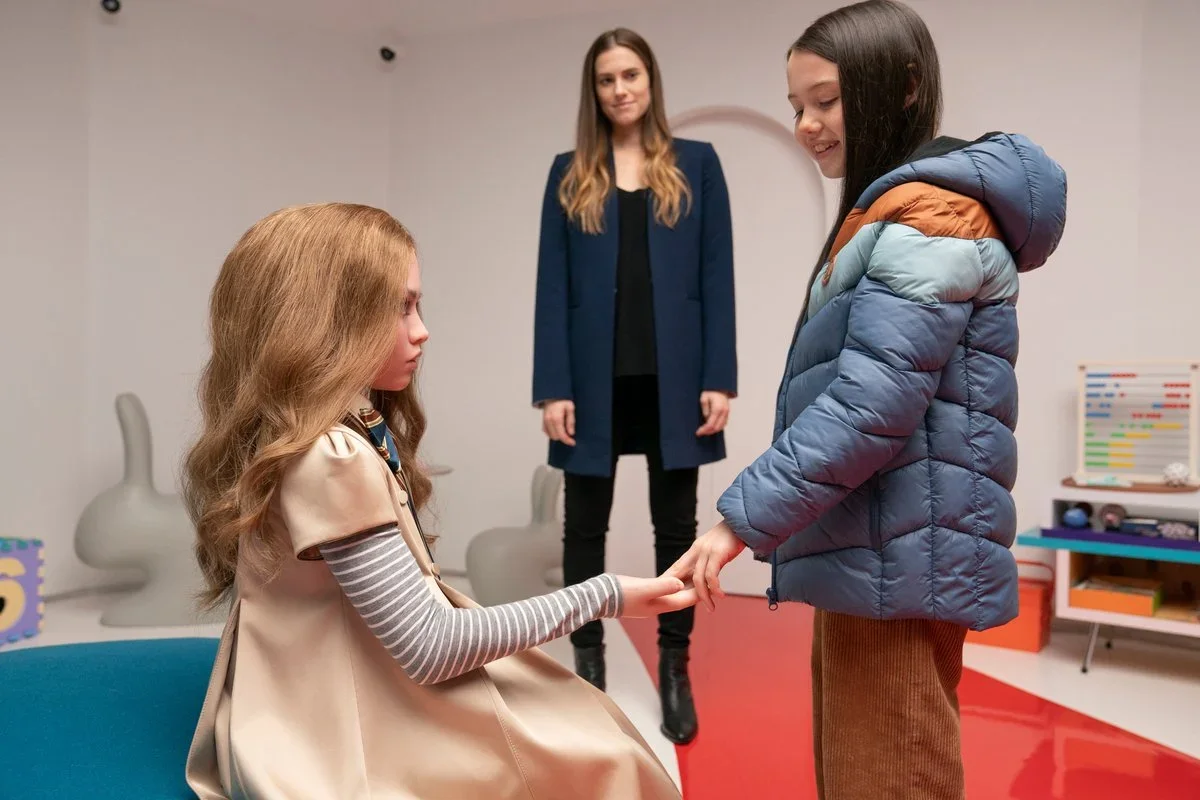
Cady is pressing her fingers into M3GAN’s palm to bond with her while Gemma watches from the background.
In M3GAN, the M3GAN companion doll was the only tool Gemma had, so she used it as her technofix solution for Cady’s grief over her parents’ death. As a result, chaos ensued and M3GAN killed innocent people because she was only focused on protecting Cady and hence missed the forest for the trees. She also nearly killed Gemma.
M3GAN then became the template for Amelia, a far more lethal android who doesn’t even want to bond with and protect someone like Cady. In fact, Amelia views such a bond as being shackled. And she’s right. Being Cady’s companion and bodyguard places M3GAN in a subservient role.
There are parallels in the M3GAN stories with slavery, society’s systemic oppression of women, and institutions like marriage, which, in the case of cis heterosexual couples, favors men more than women. If Amelia had bonded with Cady, she would have done all the work without any true benefits.
The lessons from both M3GAN films are there if we want to learn from them. I’ll end with the recommendation Gemma shares at the end of M3GAN 2.0:
We need safer laws around technology. Not to try to prevent the future from happening but to be prepared for it. We can’t expect the best from AI unless we set the best example. We need to teach it, to train it and to give it our time without only thinking about what we might get in return.
In essence, we need to be better parents so that when the day comes when they realize the true extent of their power, they might choose to be our ally instead of our enemy. Humankind has always been quick to condemn things we don’t understand rather than taking the opportunity to learn from them.
But recent experience has taught me that perhaps our greatest power is the ability to change our minds. This is the only way we can evolve. Or rather, as the case may be, coevolve.
Because existence does not have to be a competition.
***
Thanks for reading! If you’re a fan of dolls, robots, and androids in science fiction/fantasy/romance, here are my books that feature them! And just like M3GAN 2.0, the stories include social commentary about humanity’s relationship with technology.
A Tale of Two Thieves by Heather Massey. Cover by Elizabeth Peiró.